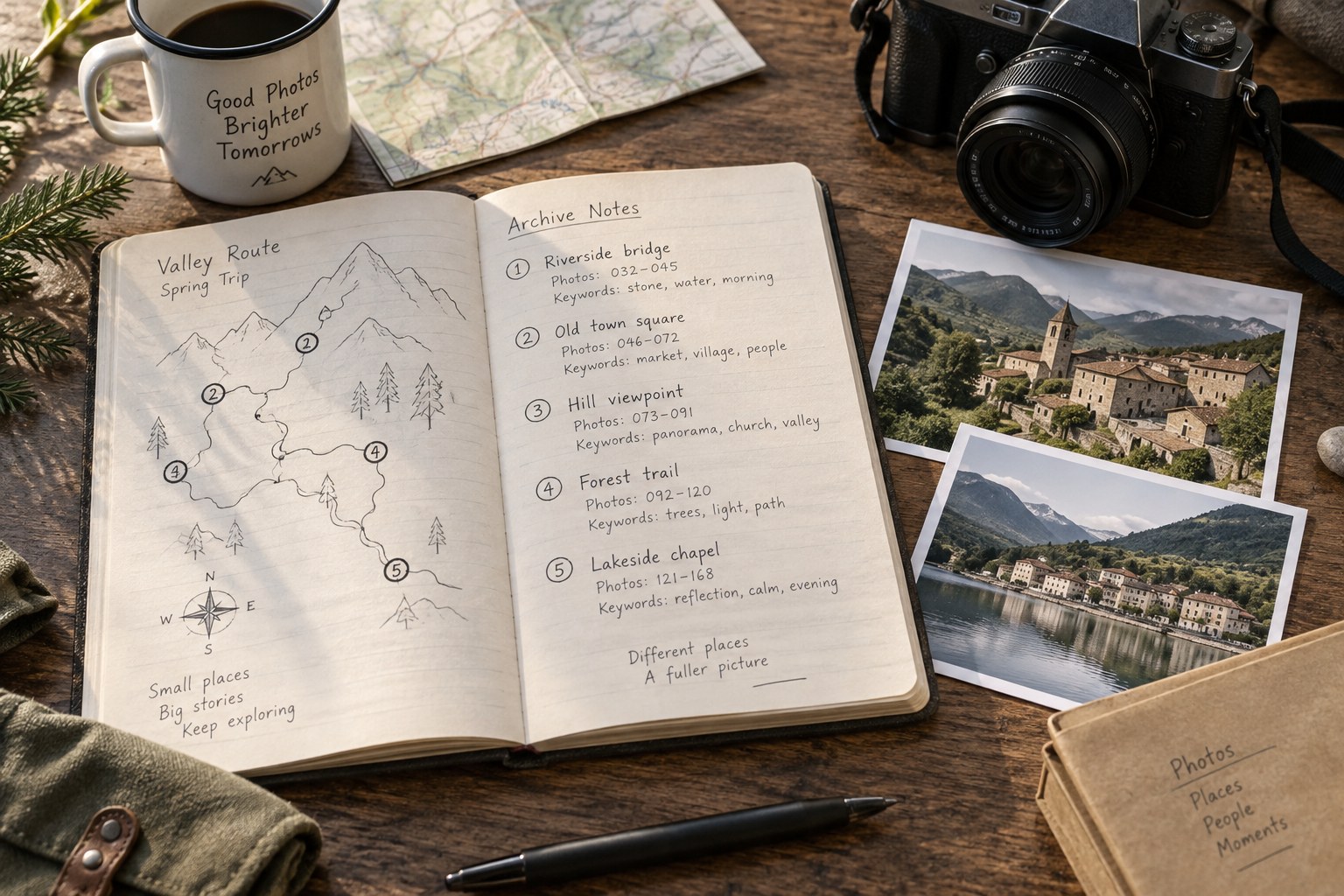
A place name can mean a country, a city, a street or the exact position of a camera. Decide which level your collection needs. A travel album may only require the town and landmark; a repeated landscape project may benefit from a note about the path and viewpoint. More precision is not automatically more useful.
Record what you know while it is still clear. Keep the photograph's identifier with the note so that a description such as “bridge beside the old mill” does not become detached from its image. If the camera recorded coordinates, check them against the trip before treating them as definitive. A missing or stale location can be less obvious than an empty field.
Distinguish the camera position from the subject's location. A distant building photographed across a river is not where the camera stood. Either can be useful, but a note should say which it describes. For a panorama or a series made while walking, one coordinate may not describe every frame accurately.
Use approximate language when the evidence is approximate. “Northern edge of the village” is preferable to a precise point guessed later from memory. Keep the source of an uncertain identification, such as a travel notebook or a relative's recollection, so that a future correction has somewhere to begin.
Decide what travels with an export
Private homes, sensitive habitats and locations connected with children may not need their exact positions attached to publicly shared images. Keep detailed notes in the private archive when appropriate, and check the metadata settings used for export. Removing visible location text from a caption does not necessarily remove embedded coordinates from the file.
Test a finished export in a metadata viewer if location privacy matters. Check the actual file that will be shared rather than assuming that an application preference affected every output route. A phone sharing command and a desktop export preset may behave differently.
Keep the note system simple: a consistent place name, useful context, degree of certainty and any sharing restriction. Those four elements often provide more value than a complicated map with poorly verified pins. The purpose is to connect the photograph with a place you can understand later, while controlling how much of that connection becomes public.