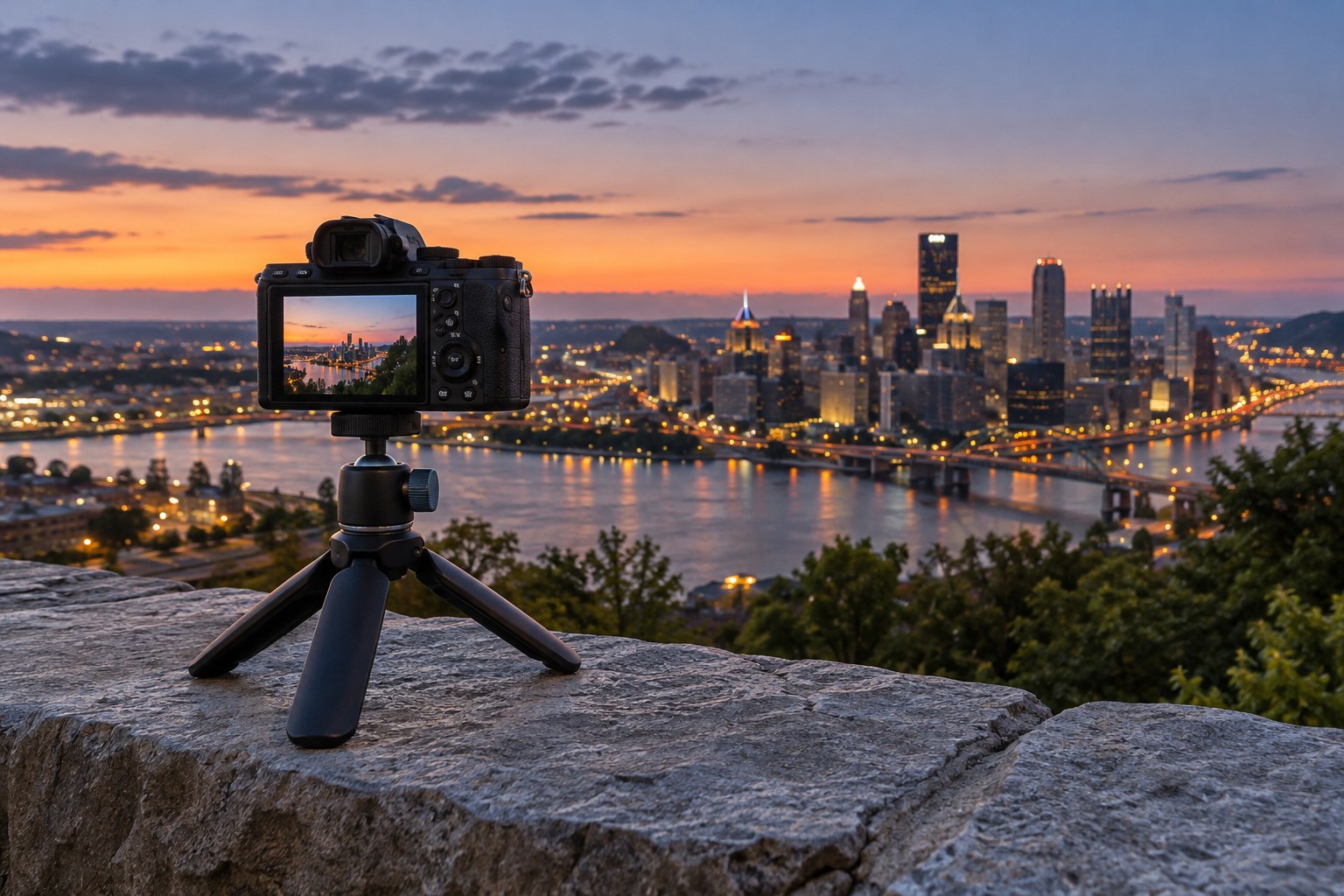
A small tripod helps when the camera needs to remain still in a place where its low height is useful. Tabletop arrangements, ground-level landscapes and repeated frames from one position are common examples. It is less useful when you need eye-level framing or when the subject itself moves. Start with the position you need, not with the promise that any tripod will improve every photograph.
Check the combined camera and lens weight against the support's specifications, but also consider balance. A long lens can place its centre of gravity far beyond a small base. The head may slowly droop even if the total weight appears acceptable. Test the actual combination close to a safe surface before trusting it near an edge.
Look for a stable place to set the tripod. A café table can vibrate when someone touches it, and a railing may be too narrow or rounded for secure feet. A lightweight support on a moving surface is not equivalent to a solid camera platform. Ask permission where appropriate and keep the setup out of other people's way.
Frame the picture before deciding that the support is worth using. A low tripod may force an angle that hides the subject or introduces a large foreground. If a raised surface is needed, make sure the whole base fits securely. Do not balance the equipment on a small ledge merely to recover the height a full-size tripod would provide.
Use a self-timer or remote release to avoid pressing the camera during the exposure. Check that straps and cables do not pull on it. Follow the equipment instructions about stabilisation when supported, because systems differ. Make a magnified check of a stationary detail rather than assuming the presence of a tripod guarantees a sharp frame.
A compact tripod can also make comparison photographs easier. Keeping position fixed lets you change lighting, focus or an object's arrangement without accidentally altering the viewpoint. Mark the feet if you need to remove and replace it, but remember that head angle and camera orientation must also be repeated.
For a walking kit, carry it only when those uses are likely. If every intended photograph contains moving people in good light, its benefit may be small. If you expect dusk views or careful still-life work, a suitable small support can remove a specific limitation without requiring a larger setup.