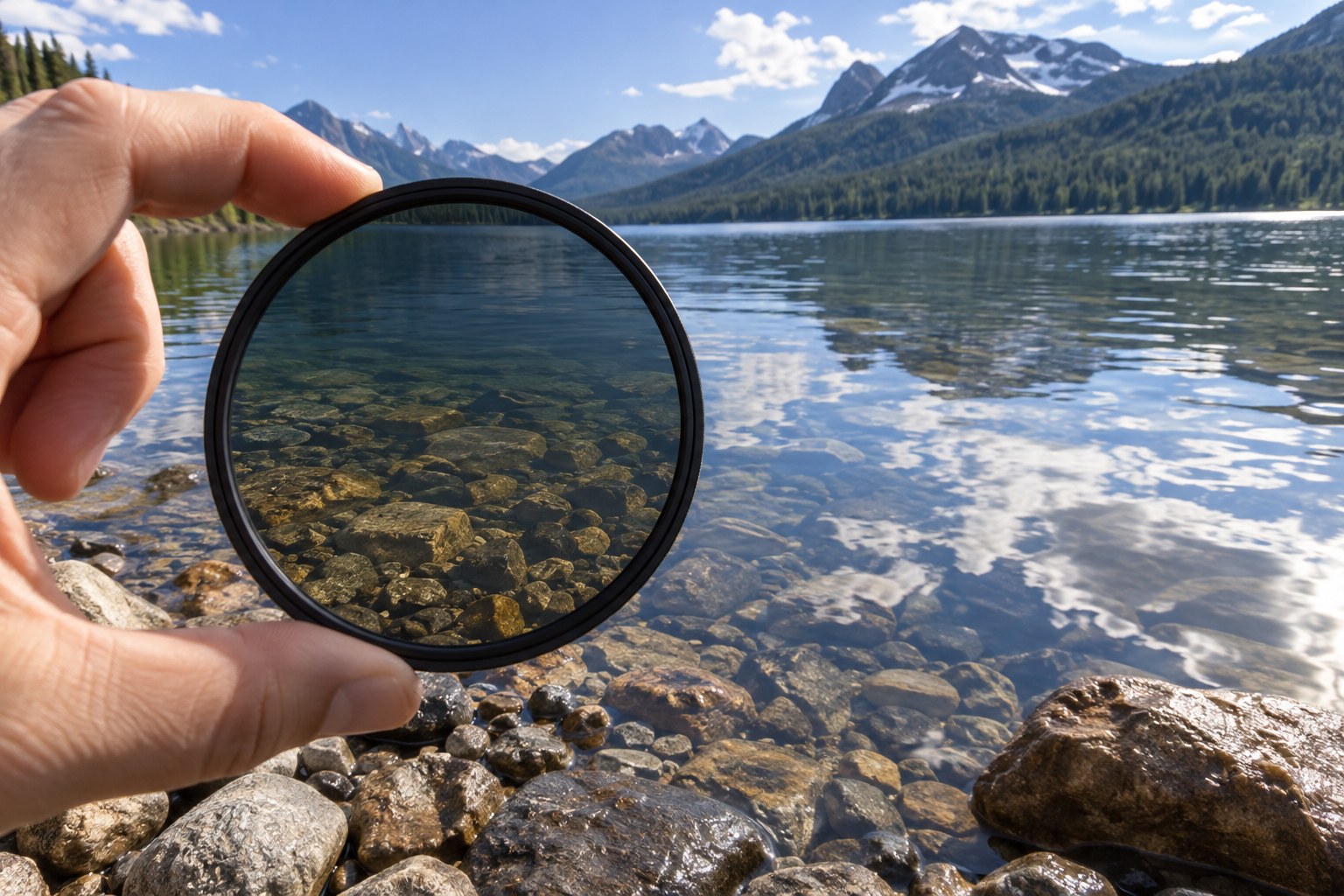
A polarising filter can change some reflections from water, glass and other non-metallic surfaces, and it can alter the appearance of parts of a blue sky. Its effect depends on geometry. Rotating the filter changes the result, but the strongest visible setting is not automatically the most useful one. Begin with a specific problem, such as glare hiding stones beneath shallow water.
Fit a compatible filter of the correct size without forcing the thread. Make an unfiltered reference first. Then rotate the polariser while watching the area that matters. You may reveal colour beneath a reflection, but you may also remove the reflection that explains the surface. A lake without any reflected sky can look less like water, even when the submerged detail becomes clearer.
Check the whole frame after rotating
On a wide view, different parts of the sky can respond differently because they lie at different angles to the sun. A very dark patch beside a much lighter area may look unnatural. Reduce the effect, change the framing or remove the filter if the unevenness dominates. Do not assume that a stronger blue always means a better sky.
The same rotation may improve one surface and worsen another. A shop window can become clearer while a polished object nearby keeps a distracting reflection. Curved surfaces contain many angles at once, so no single setting removes everything. Decide which area has priority and examine the rest for changes before making the exposure.
A polariser reduces the light reaching the camera. Automatic exposure may compensate with a slower shutter, a wider aperture or higher ISO. Watch those settings when photographing moving leaves, people or handheld scenes. The change in reflections does not excuse movement blur on the main subject. If light is already limited and the effect is minor, removing the filter may be the better choice.
Use a comparison that isolates its benefit
Keep camera position and framing fixed for the filtered and unfiltered versions, and match their general brightness. Otherwise a darker exposure can appear more saturated even when the filter contributes little. Compare the actual reflection, texture and colour relationships rather than the overall punch of the image.
For foliage, the filter may reduce bright surface glare and reveal more colour. Check whether the result still has useful highlights that describe leaf shape. Removing too much shine can flatten a scene with many overlapping leaves. A partial rotation can be more balanced than the maximum effect.
Inspect corners when combining the polariser with other filters or adapters, especially on a wide lens. Stacked mounts can intrude into the view or increase unwanted reflections. Use only the components needed for the photograph and make sure none has loosened while rotating the front ring. Clean fingerprints before working into bright light.
A useful field test is a scene containing both wet stones and reflected sky in a stream. Rotate the filter slowly and note the point where stone colour becomes clearer but enough reflection remains to describe the water surface. Make that frame, then one at maximum suppression. The partial setting may communicate the scene more completely even though the maximum setting appears more technically effective.
Repeat the comparison after changing camera height. The angle to the water changes, so the previous filter position may no longer give the same balance. This demonstrates why copying a rotation mark from one setup to another is less useful than observing the actual reflection each time.
If making several frames for a panorama, consider whether changing direction will change the sky effect across the sequence. A fixed rotation does not guarantee a uniform result as the camera turns. Test the whole sweep or leave the filter off when a smooth sky is essential. The filter is most useful when it solves a visible surface problem without creating a larger tonal inconsistency elsewhere.
Review the final pair after the immediate excitement of the stronger colours has passed. Keep the version that makes the subject more understandable. Sometimes that means clear water; sometimes it means a reflection left partly intact. The decision should follow what the photograph needs to describe.