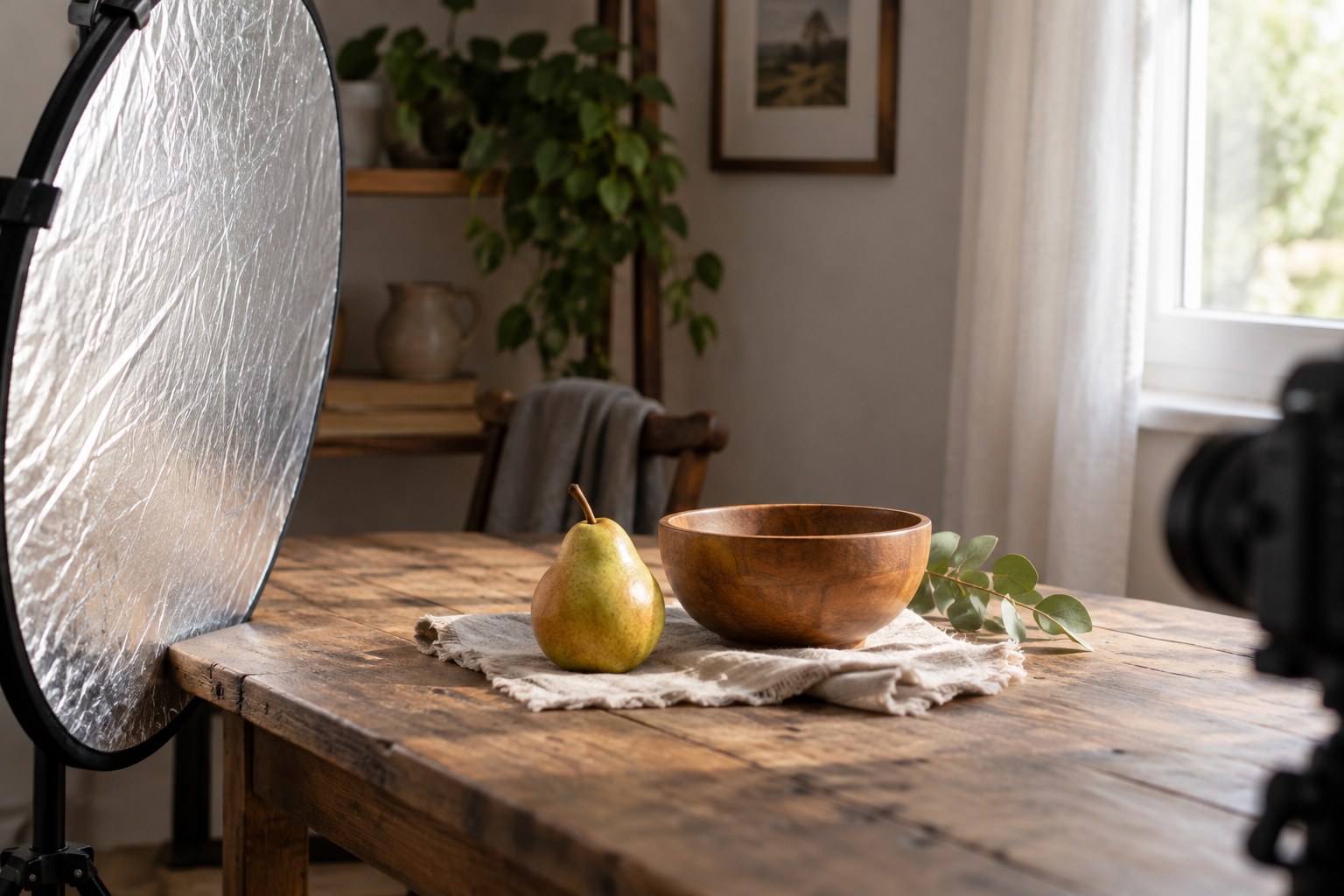
A reflector can make a small still life easier to read without adding another powered light. The simplest version is a piece of matte white card beside the object. Its usefulness comes from placement: it must receive light and return some of it towards the area you want to brighten.
Set up one object near a window and make a reference frame. Keep exposure fixed. Bring the card towards the shadow side and watch a specific feature, such as the underside of a cup handle or the fold of a cloth. Move the card closer, farther away and through a few angles. The strongest effect is not always produced by pointing it directly at the camera.
Use a card large enough to produce a gradual change across the object. A tiny reflector can create a small bright patch, while a larger one may open the whole shadow side. If the result becomes flat, pull it back or angle it away. You want enough shadow to retain the object's volume, especially with rounded forms.
Glossy materials show the reflector itself. A white card may become a visible rectangle in a ceramic glaze or metal surface. Treat that shape as part of the composition. Rotate or trim the card only when the resulting reflection improves the object; do not assume every visible reflection is a defect. A smooth highlight can describe a curve more clearly than a uniformly lit surface.
Keep the reflector stable between frames. Leaning it against a light object can move the subject, and holding it by hand may change the reflection while you release the shutter. Use a safe support outside the frame and check that its shadow is not visible. The support should be easy to remove without disturbing the arrangement.
Compare white and dark card if you want to understand the opposite effect. A dark card reduces some surrounding reflected light and can deepen an edge or shadow. It does not emit darkness; it changes what the object sees around it. This can be useful when a pale object lacks a readable boundary against a light background.
Save the unmodified frame alongside the final choice. Review both at normal size, checking whether the reflector reveals an important feature or merely makes everything brighter. For a series of objects, mark the card position and repeat the setup, but expect to adjust it for different surface shapes rather than treating one placement as universal.